
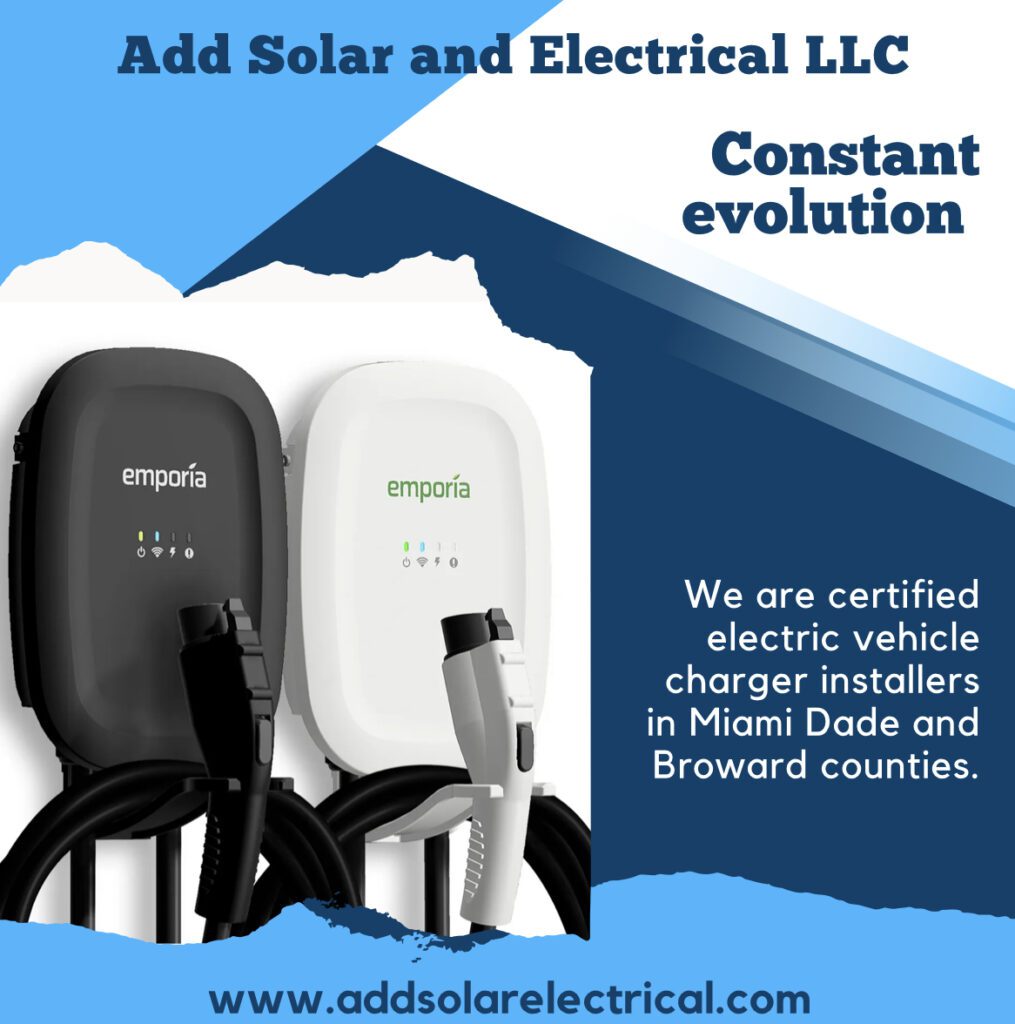
Charging at home is the easiest way to own an electric vehicle in South Florida. You plug in at night, and the car is full every morning. But a home EV charger is a 240-volt appliance that can draw as much power as a central A/C unit, so the circuit, the panel and the installation details matter. This guide explains what Broward homeowners need to know before installing a Level 2 charger, from choosing the right amperage to permits, condo rules and costs.
If you already know what you need, see our EV charger installation services in Miami-Dade, Broward and Palm Beach or request a free estimate.

Level 1 vs. Level 2: What Home Charging Really Looks Like
Most EVs come with a cord that plugs into a regular 120V outlet (Level 1). It works, but it is slow. A Level 2 charger runs on a dedicated 240V circuit and is what most homeowners install.
| Level 1 (120V outlet) | Level 2 (240V charger) | |
|---|---|---|
| Typical range added per hour | About 3–5 miles | About 20–45 miles, depending on amperage and vehicle |
| Full charge overnight | Rarely, for most daily drivers | Yes, for virtually every daily commute |
| Electrical work | Usually none | Dedicated 240V circuit, sized to the charger |
| Best for | Plug-in hybrids, very low mileage | Full battery EVs, two-EV households |
Choosing the Right Amperage for Your Home
Because EV charging is a continuous load, the electrical code requires the circuit to be sized at 125% of the charger’s output. That is why a 32-amp charger needs a 40-amp circuit and a 48-amp charger needs a 60-amp circuit.
- 32A charger on a 40A circuit (about 7.7 kW): enough for most single-EV homes and commutes across Broward and Miami-Dade.
- 40A charger on a 50A circuit (about 9.6 kW): a good middle ground when panel capacity is limited.
- 48A charger on a 60A circuit (about 11.5 kW): useful for larger batteries, two EVs, or drivers who need a quick top-up during the day.
Before you buy a bigger charger, check your car’s onboard charger rating. If your vehicle only accepts about 7 kW, a 48A unit will not charge it any faster. It will only require a larger and more expensive circuit.
Hardwired or Plug-In (NEMA 14-50)?
Many chargers can either plug into a NEMA 14-50 receptacle or be hardwired. Under the electrical code Florida currently enforces, 240V receptacles in garages and outdoors require GFCI protection. Most EV chargers also have their own built-in ground-fault protection, and the two can conflict and cause nuisance tripping. For that reason, we usually recommend hardwiring the charger. It is cleaner, it supports higher amperage, and it avoids worn receptacles from repeated plugging and unplugging.
Will My Electrical Panel Handle an EV Charger?
This is the most important question, especially in older Broward and Miami-Dade homes that still have 100-amp service. Before recommending anything, we do a load calculation that accounts for your A/C, water heater, dryer, range, pool equipment and any other large loads. Depending on the result, there are three common paths:
- Dedicated circuit only: your panel has enough capacity and breaker space.
- Load management: a smart charger setting or energy management device lowers charging power when the house is using more electricity. It often avoids a panel upgrade.
- Panel or service upgrade: needed when the home is already near its limit, or when the panel is an outdated or recalled model such as FPE Stab-Lok or Zinsco. Learn more about our electrical panel upgrades.
Home EV Chargers We Install
We install most major brands, including the Tesla Wall Connector and Universal Wall Connector, ChargePoint Home Flex, Emporia, Wallbox, Grizzl-E, Blink and GM Energy PowerShift. If you are buying a new charger, ask us before ordering. We will confirm it matches your vehicle, your circuit and your Wi-Fi coverage in the garage.
A note on connectors: many new EVs now ship with the NACS (Tesla-style) port, while many older EVs and chargers use J1772. Adapters work in both directions, and some chargers include both. If your household has two different EVs, we will help you choose a charger that works for both.
Living in a Condo or Townhome?
Florida law (Section 718.113(8), Florida Statutes) gives condominium owners the right to install an EV charger in their assigned limited common element parking space, and the association cannot prohibit a properly submitted request. The law also sets conditions:
- The owner pays for installation, operation, maintenance and repair.
- The electricity used for charging must be separately metered.
- The association may require compliance with building codes and its architectural standards, the use of contractors experienced with EV charger installations, and insurance coverage.
We can visit the building, review the electrical room and parking area, and provide the documentation most boards ask for. If your association wants chargers for the whole building instead, see our commercial and condo EV charging guide.
South Florida Installation Details That Matter
- Outdoor and carport installs: use a charger rated for outdoor use (NEMA 3R or NEMA 4), with weather-tight fittings and cable management that keeps the connector off the ground.
- Storms and surges: lightning and grid switching after storms are common here. A whole-home surge protector is an inexpensive way to protect the charger and the vehicle’s electronics.
- Flooding: in low-lying areas, we mount the charger and any disconnect at a sensible height and route conduit to avoid standing water.
- Permits and inspection: adding a 240V circuit typically requires an electrical permit from your city or county building department. We pull the permit and schedule the inspection for you.
What Affects the Cost of a Home EV Charger Installation?
Every home is different, so we quote after a site visit. The main factors are:
- Distance from the panel to the charger location, and whether the wiring runs through an attic, along an exterior wall or underground
- Charger amperage and wire size
- Available panel capacity, and whether load management or a panel upgrade is needed
- Permit fees in your city
- Whether you supply the charger or we provide it
Incentives and Utility Options in 2026
The federal tax credit for home charging equipment (Section 30C) ended for equipment placed in service after June 30, 2026, so be cautious with any website that still promises it. FPL also offers its own subscription home-charging program with off-peak pricing. It is worth comparing with owning your charger outright, and we are happy to talk through both options with you.
Pair Your Charger with Solar or Battery Backup
An EV can add several hundred kilowatt-hours a month to your FPL bill. If you are planning solar panels, include the EV in the system size from the start. With a Tesla Powerwall 3, you can also keep essential loads running during outages, while managing when the car charges.
Our Home EV Charger Installation Process
- Site visit and load calculation: we review your panel, service size and the best charger location.
- Recommendation and quote: charger type, amperage, wiring route and any panel work, in writing.
- Permit: we file it with your building department.
- Installation: dedicated circuit, breaker, conduit and charger mounting. Most homes are done in one day.
- Testing, app setup and inspection: we confirm safe operation, set up scheduling for off-peak charging, and meet the inspector.
Home EV Charger FAQs
How long does a home EV charger installation take?
Most residential installations take a few hours to one day once the permit is approved. Jobs that include a panel upgrade or long underground runs take longer.
Do I need a permit to install an EV charger in Broward?
In most cases, yes. Installing a new 240V circuit typically requires an electrical permit and a final inspection. As a licensed Florida electrical contractor (EC13010894), we handle both.
Can a Tesla Wall Connector charge a non-Tesla EV?
Yes, with the right setup. Vehicles with a NACS port can use it directly, and Tesla’s Universal Wall Connector also includes a J1772 adapter for other EVs.
How much will charging at home add to my FPL bill?
Divide the miles you drive per month by your car’s efficiency (often around 3–4 miles per kWh), then multiply by the rate on your FPL bill. For example, 1,000 miles at 3.5 miles per kWh is about 285 kWh per month. Scheduling charging for off-peak hours can lower the cost further on eligible plans.
Do I need a panel upgrade for an EV charger?
Not always. Many homes have enough capacity, and others can use load management instead. We confirm with a load calculation before recommending an upgrade.
Ready to Charge at Home?
Add Solar & Electrical installs home EV chargers across Broward, Miami-Dade and Palm Beach, with permits, load calculations and inspections handled by a licensed team. Request your free estimate or call 786-917-9217.
